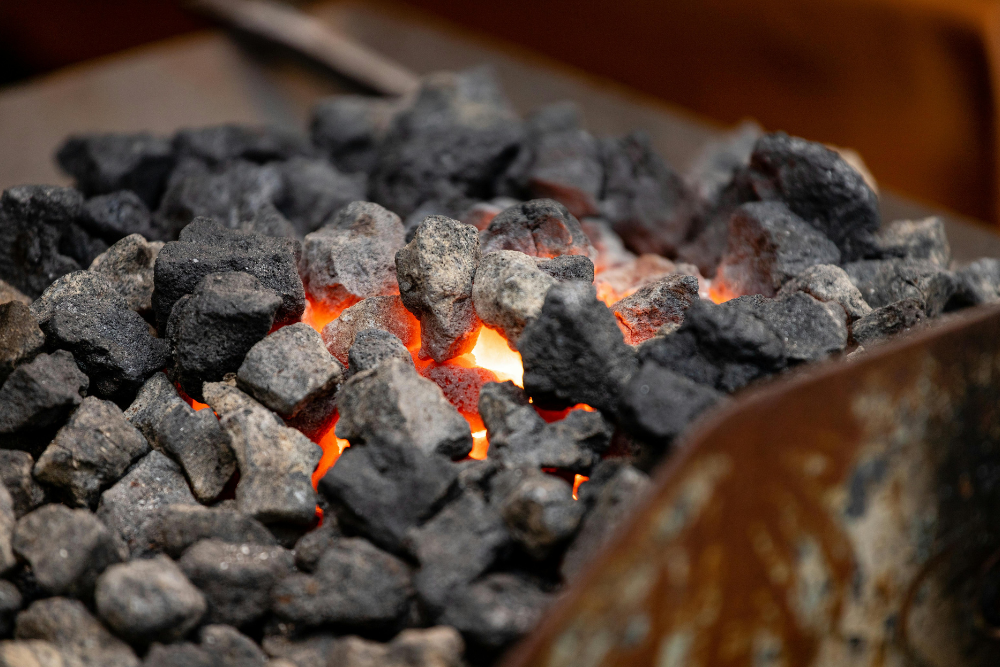
Datt Capital holds approximately 20% in thermal coal across both funds. Here is the investment thesis behind New Hope, Yancoal, and Whitehaven heading into FY2027.
~ 6 min. read
By: Datt Capital

Approximately 20% of Datt Capital's funds are currently invested in thermal coal producers: New Hope Corporation, Yancoal, and Whitehaven Coal. For some investors, that number will prompt a question. For others, it will prompt several. This article addresses them directly. The thesis is not ideological. It is structural, grounded in supply and demand dynamics that are playing out in real time across global energy markets, and anchored in the same cash flow discipline that guides every other position in the portfolio. For the context in which this position sits, see Owning Cash Flow, Not Hope: Datt Capital's Investment Bias for FY2027.
Seaborne LNG prices are rising sharply due to a structural shortfall in supply following Qatar's reduced market access. Qatar supplies approximately 20% of the world's seaborne LNG. With that supply impeded, European and Asian buyers are competing for the remaining 80% of a market that was already tightly balanced. Gas storage levels across both regions are significantly below their seasonal averages. As LNG becomes expensive and scarce, thermal coal becomes the substitution fuel of choice for power generation. The economics follow directly: constrained LNG supply drives thermal coal demand, which drives seaborne thermal coal prices materially higher in the second half of FY2027. For the broader market signal supporting this view, see ASX Market Outlook: Thermal Coal Near 52-Week Highs.
The relationship between LNG and thermal coal is not widely understood outside the energy sector. Both are used for power generation. When LNG is cheap and available, utilities prefer it for its lower emissions profile. When LNG becomes expensive or scarce, the economic calculation changes. Thermal coal, which is significantly cheaper on an energy equivalent basis when LNG prices spike, becomes the practical alternative for utilities that have the infrastructure to use it.
This substitution dynamic has played out before. The most directly comparable situation was 2021, when Russia's invasion of Ukraine effectively locked Russian gas out of European markets. The resulting LNG shortage drove seaborne thermal coal prices to record highs as utilities across Europe and Asia scrambled for alternative fuel sources. The setup entering the second half of FY2027 is analogous. Qatar's reduced market access has removed a significant portion of seaborne LNG supply from global markets at precisely the moment when storage levels are at their lowest seasonal levels in years.
As he explains: "Both Europe and Asia will be competing with each other for the remaining 80% of the market that still functions. This will push a lot more demand into purchasing thermal coal given LNG is very expensive now relative to thermal coal."
For how this dynamic intersects with the broader energy safe haven thesis, see When Safe Havens Stop Working: Energy as the Real Flight to Safety.
The three positions share a common investment profile: established producers with low-cost operations, fortress balance sheets, and a demonstrated track record of returning cash to shareholders.
New Hope Corporation is one of Australia's lowest-cost thermal coal producers with a long mine life and a history of strong dividend payments. Its cost structure means it remains highly profitable across a wide range of coal price scenarios, not just at elevated price levels.
Yancoal is one of the largest coal producers in Australia by volume, with diversified operations across New South Wales and Queensland. Its scale provides operational resilience and the balance sheet capacity to sustain meaningful shareholder returns through a commodity price cycle.
Whitehaven Coal operates high-quality metallurgical and thermal coal assets with strong export exposure to Asian markets. Its portfolio is well-positioned to benefit from both the thermal coal substitution dynamic and the continuing demand for high-quality coking coal from Asian steel producers.
The common thread across all three is capital discipline. Post-2020, the Australian energy sector broadly adopted prudent capital allocation frameworks that prioritised shareholder returns over speculative growth. The result has been a cohort of businesses that generate significant free cash flow at current commodity prices and return the majority of it to shareholders through dividends and buybacks. For Emanuel's broader market insights on energy positioning, see Emanuel on Money of Mine: Market Strategy and Insights. For the full structural energy thesis, see Energy Capex Deficit: The Structural Case for ASX Energy.
The ESG dimension of a 20% thermal coal position is not something Datt Capital sidesteps. The position is deliberate, informed, and subject to the same rigorous analysis as every other holding in the portfolio. Several points are worth making directly.
First, thermal coal demand is not declining at the pace that many transition scenarios assumed. The reality of global energy consumption, particularly across developing Asia, is that coal continues to provide the majority of baseload power generation for billions of people. The transition to renewables is occurring, but it is occurring more slowly and less uniformly than the most optimistic projections suggested.
Second, the ESG-driven divestment of coal assets by institutional investors has not reduced global coal consumption. It has transferred ownership of those assets to less transparent private holders while removing the governance influence that institutional shareholders could otherwise exercise. The practical effect has been to make coal a less regulated, less scrutinised, and often less environmentally responsible industry.
Third, the investment case for these specific companies is grounded in their role as essential providers of the energy that modern economies depend on in the present, not in advocacy for the long-term future of coal as an energy source. The position is sized for the FY2027 cycle, not held as a permanent structural allocation.
His position on this is straightforward: "One cannot print molecules. The hard reality is that green energy technologies have not matured enough to replace baseline energy needs across the board."
For Datt Capital's broader thinking on energy transition timing and its investment implications, see What a Closed Strait Means for Your Portfolio.
A position of this size in a single commodity theme carries specific risks that investors should understand.
Commodity price risk is the most obvious. If seaborne thermal coal prices do not rise as expected, the investment thesis is weakened. The LNG shortage thesis depends on Qatar's reduced market access persisting and gas storage levels remaining below seasonal averages. Either of these conditions reversing would reduce the substitution dynamic that underpins the near-term coal price thesis.
Regulatory risk is a secondary consideration. Australian thermal coal exports are subject to ongoing policy scrutiny, and any significant change to export regulations or carbon pricing mechanisms could affect the economics of domestic producers.
Transition risk over a longer horizon is real. Thermal coal's role in global power generation will diminish over time as renewable capacity expands. The position is sized and managed with this in mind. It is a cyclical, medium-term allocation, not a permanent structural holding.
For investors concerned about how Datt Capital manages commodity concentration risk within the portfolio, the broader five-bucket framework provides the context. The coal position is one component of a diversified approach that also includes technology, healthcare, discretionary retail, and strategic assets. See ASX Market Outlook FY2027: Key Themes for Investors for the full picture. For how sequence of returns risk applies in a commodity-concentrated position, see Sequence of Returns Risk and the Limits of Average Returns.
The 20% allocation to thermal coal is the most concentrated single-theme position in Datt Capital's current portfolio. It reflects a high-conviction view on a specific supply and demand dynamic with a clear near-term catalyst and a well-understood risk profile. The position is held in both the Datt Absolute Return Fund and the Datt Small Companies Fund, sized to reflect the higher certainty of the thesis relative to other positions in the portfolio.
For wholesale investors evaluating Datt Capital's current positioning, the coal thesis is best understood as the practical expression of a broader philosophy: own the assets that the world needs right now, available at a price that reflects the market's underappreciation of the near-term supply dynamic.
The 20% thermal coal position in Datt Capital's funds is not incidental. It is the highest-conviction expression of the structural energy thesis that runs through the FY2027 portfolio. The LNG shortage, the substitution dynamic, the capital discipline of Australian coal producers, and the cash flow certainty of established low-cost operations all converge to produce one of the more compelling near-term investment cases available in Australian equities today. The ESG dimension is acknowledged, not avoided. The risks are understood and managed. The thesis is grounded in physical supply and demand reality, not in a speculative price scenario.
To learn more about Datt Capital's current portfolio positioning and investment approach, visit our investment philosophy page or contact our Distribution Manager, Daniel Liptak, at 0419 004 524 or daniel@datt.com.au.
Disclaimer: This article does not take into account your investment objectives, particular needs or financial situation; and should not be construed as advice in any way. The author may hold stocks discussed in this article. Forward-looking statements reflect the author's views at the time of writing and are subject to change. Past performance is not indicative of future results.

Investment Excellence with a Proven Edge
Datt Capital Pty Ltd
ABN 37 124 330 865
AFSL 542100
390 St Kilda Rd, Melbourne VIC 3004
© COPYRIGHT 2025. ALL RIGHTS RESERVED.
Datt Capital Pty Ltd
ABN 37 124 330 865
AFSL 542100
390 St Kilda Rd, Melbourne VIC 3004
© COPYRIGHT 2026. ALL RIGHTS RESERVED.
The information on this website is prepared and issued by Datt Capital Pty Ltd (ABN 37 124 330 865 AFSL 542100) (Datt Capital). Unless otherwise stated, the information is intended for wholesale clients within the meaning of section 761G or 761GA of the Corporations Act 2001 (Cth) (Corporations Act).
Datt Capital is the investment manager of the Datt Capital Absolute Return Fund (APIR FHT3309AU), the Datt Small Companies Fund Class A (APIR FHT4217AU), and the Datt Small Companies Fund Class B (APIR FHT4217AU) (together, the Funds). Fundhost Limited (ABN 69 092 517 087 AFSL 233045) (Fundhost) is the issuer and trustee of each Fund.
The Datt Capital Absolute Return Fund and the Datt Small Companies Fund Class A are available to wholesale investors only and must not be made available to any persons that are "retail clients" for the purpose of the Corporations Act. An investment in either of these Funds is available directly through a valid application form attached to the relevant information memorandum, through the Olivia123 direct application platform, or through selected investor directed portfolio service (IDPS) platforms. Before making any decision to make or hold any investment in either Fund you should consider the relevant information memorandum in full. The Datt Small Companies Fund Class B is available to retail investors only, exclusively through selected investor directed portfolio service (IDPS) platforms. Before making any decision to make or hold any investment in this Fund you should consider the relevant Product Disclosure Statement (PDS) in full. The PDS is available on request by contacting Datt Capital directly.
The information contained on this website or in any email is not intended for distribution to, or use by, any person or entity in any jurisdiction or country where such distribution or use would be contrary to law or regulation, or which would subject Datt Capital or Fundhost to any registration or other requirement within such jurisdiction or country. Datt Capital may provide general information to help you understand our investment approach. Any financial advice we provide has not considered your personal circumstances and may not be suitable for you. To the extent permitted by law, Datt Capital and Fundhost, their officers, employees, consultants, advisers and authorised representatives, are not liable for any loss or damage arising as a result of any reliance placed on this document. Information has been obtained from sources believed to be reliable, but we do not represent it is accurate or complete, and it should not be relied upon as such. Datt Capital and Fundhost do not guarantee investment performance or distributions, and the value of your investment may rise or fall. Past performance is not an indicator of future performance.