
A practical guide to selecting a fund manager in Australia, focusing on long-term performance, discipline, risk management, and team alignment.
~ 8 min. read
By: Datt Capital

To choose a fund manager in Australia, check three things in order: whether the business is well run, whether its performance holds up across full market cycles, and whether its returns come from skill or from a style the market happened to reward. Each check answers a different question, and investors often treat the first as an answer to the second.
That confusion is expensive. A Datt Capital analysis of FundMonitors.com data on 237 Australian equity funds through August 2026 found that funds holding a research rating did not outperform unrated funds over three or five years. Over the most recent year, rated funds trailed unrated funds by a statistically significant margin.
This guide sets out how to evaluate an Australian fund manager with that evidence in mind: what a research rating can tell you, what a track record predicts, and which questions to ask before investing.
In Australia, there are hundreds of managed funds across Australian equities, small companies funds, absolute return strategies, and income-focused mandates. With that level of choice, investors need a clear framework to separate managers with genuine skill from those who have benefited from a favourable market.
Strong recent performance tells investors little on its own. S&P's most recent scorecard found that of 70 Australian equity funds in the top quartile in 2023, only five remained there in both 2024 and 2025. How professional investors assess Australian fund managers follows a more structured path than chasing last year's top performer, and the sections below set out that path.
The most reliable way to assess any fund manager is through three dimensions: Performance, Process, and People. They do different jobs. Process and People show whether a manager is well run and unlikely to take risks investors have not agreed to. Performance history, used carefully, carries more information about future relative returns.
Performance is more than headline returns. It reflects how the manager behaves across different market conditions, how they manage risk during periods of stress, and whether the results match the fund's stated objective.
When reviewing performance, look for consistency across full market cycles. A fund that delivered strong returns over the past twelve months in a broadly rising market tells you less than one that also preserved capital during the 2020 COVID drawdown or the 2022 rate shock. Risk-adjusted returns, maximum drawdown, and recovery time are more informative than annual return alone.
Multi-year records do carry information. In the Datt Capital analysis, each fund's record was split into two periods: September 2021 to August 2024, and the two years that followed. A fund's rank in the first period was a meaningful guide to its rank in the second, with a rank correlation of 0.37. That signal was stronger than any research rating produced.
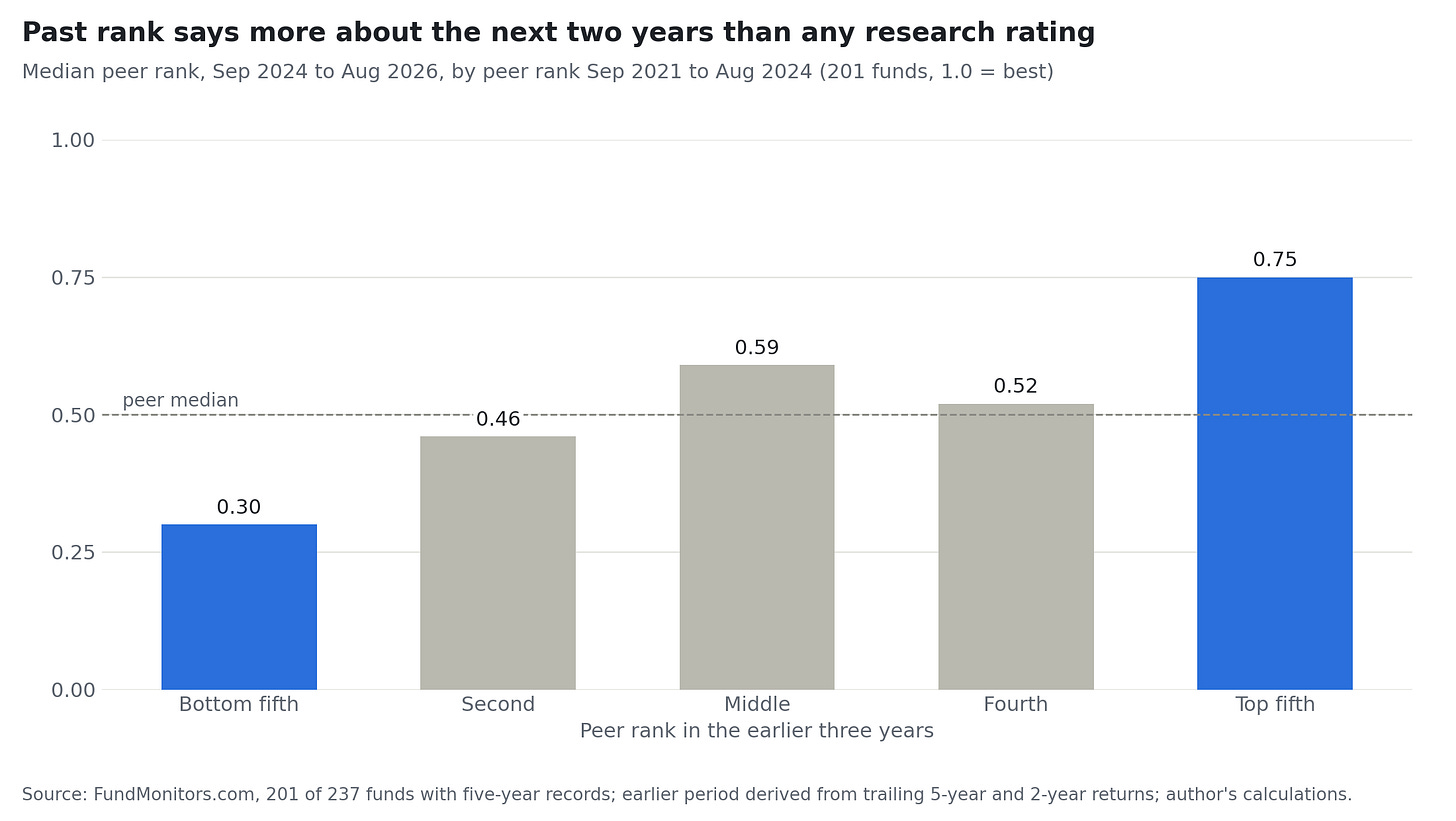
The signal is most useful at the bottom of the table. Of the funds in the weakest fifth during the first period, only around one in three reached the upper half afterwards. Persistent underperformance, particularly when paired with high fees, tends to continue. For most investors, identifying the funds to avoid is a more reliable exercise than predicting next year's leader.
"It's simpler to eliminate the worst performers than it is to identify the best." - Daniel Liptak, Head of Distribution
Two caveats apply. Funds that closed or merged drop out of the data, which flatters persistence. A winning investment style can also keep working for several years before reversing, so part of what looks like persistent skill may be style momentum. The section on separating skill from style below covers how to test for this.
Daniel highlights: "Many of the worst-performing Highly Recommended funds this year had a growth bias, and style exposure can be obtained at a low cost."
Capital preservation is a principle that separates managers with genuine downside discipline from those whose performance reflects pure market exposure. A manager who limits losses compounds from a stronger base, producing better outcomes over time even if peak returns appear lower.
Datt Capital's decisions on Afterpay and SiteMinder illustrate how a disciplined process supports long-term performance. Afterpay was first added near seven dollars a share, on clear evidence of structural growth and strong product adoption. In 2025, the team increased its position in SiteMinder during a thirty percent drawdown, recognising the strength of its recurring revenue model and the critical role its software plays for hotels. Both decisions are examined in detail through the lens of navigating volatile markets.
Process determines how a manager behaves when conditions turn against it. A strong investment process is transparent, documented, and tied to a clear investment philosophy that holds steady through changing market conditions and short-term sentiment.
Process consistency is observable in how a manager behaves during periods of market stress, when the temptation to deviate from a stated approach is strongest. Managers who hold to their framework during volatility are more likely to deliver the outcomes their investors expect.
When assessing process, ask the manager to explain specifically how they identify investment opportunities, how they size positions, how they manage downside risk, and under what conditions they reduce or exit a position. Vague or marketing-heavy answers are a warning sign. Disciplined research and its role in portfolio construction is what distinguishes a repeatable process from one built on market conditions.
Look also for evidence of independent thinking. The distinction between volatility and risk is one that disciplined managers understand and apply consistently. Managers whose research draws primarily on broker reports and consensus forecasts tend to hold the same risks as the broader market. Understanding common red flags in manager due diligence helps investors identify where hidden risk is being taken on without adequate disclosure.
In Australia, a fund generally needs a recommendation from a research house before it reaches an approved product list, a platform menu, or an adviser's model portfolio. Ratings carry real weight in where money flows, so investors should be clear about what they assess.
A research rating evaluates the people, the process, the business behind the fund, and its suitability for a platform. That is useful evidence. A well-governed manager with a clear process is less likely to misstate risk or drift from its mandate. Suitability for recommendation and likelihood of outperformance are separate questions, though, and the Datt Capital analysis shows the first does not answer the second. Rated and unrated funds each beat the index about one-third of the time over three years, and higher grades did not line up with higher returns.
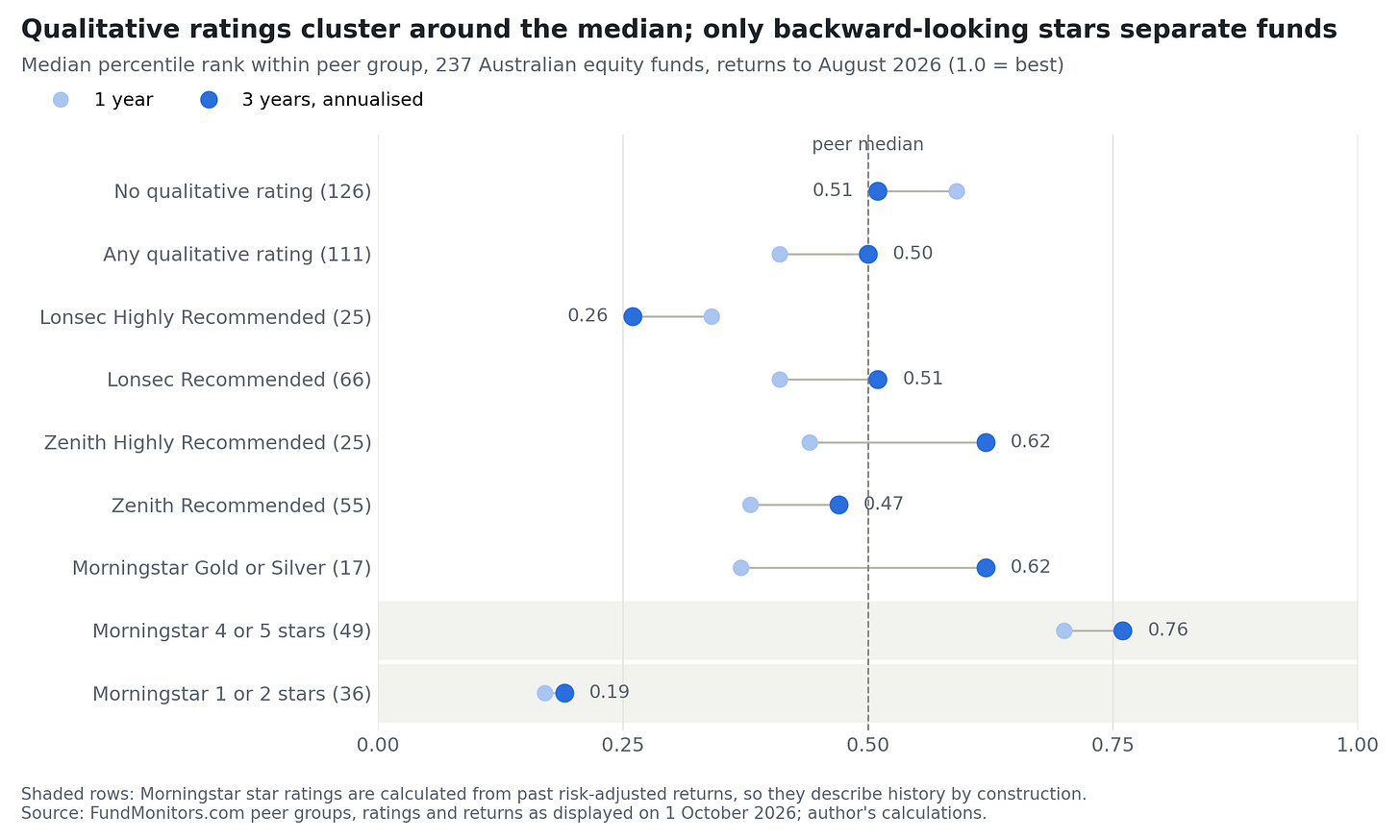
Dot chart comparing the median peer rank of rated and unrated Australian equity funds over one and three years.
Two features of the system explain the gap. Upgrades tend to follow strong periods and downgrades weak ones, so a rating often confirms returns that have already happened. Researchers also favour clear, consistent approaches, which can cluster recommendations in whichever style has recently worked.
The practical conclusion is to treat a rating as a qualification to look at a fund, then let the rest of the evidence decide.
"Suitability for recommendation and likelihood of outperformance are two different issues, and the market regards the first as a response to the second." - says Daniel.
People make every investment decision in a fund. A stable, experienced investment team with deep domain knowledge and low turnover is one of the clearest signs that a manager will behave consistently through difficult periods.
Key questions to ask include how long the core investment team has worked together, whether key decision-makers have personal capital invested in the fund alongside clients, and whether the team has navigated multiple market cycles together.
Manager alignment is particularly important. A manager who invests personal capital in the fund has a direct financial interest in managing risk responsibly. This structure removes the principal-agent problem that exists when a manager earns fees regardless of investor outcomes.
Much of what looks like manager skill is exposure to an investment style. Over the past decade in Australian equities, quality and growth approaches produced the most coherent investment stories and attracted many of the strongest ratings. When that style turned, highly recommended funds tended to fall together, and a large share of this year's weakest highly recommended funds carried a growth bias.
Before crediting a manager with skill, check how much of the return is explained by exposure to value, quality, size, and momentum. Style exposure is available cheaply through index products. A manager earns an active fee for the return that remains once style is accounted for.
Fees matter, but they should never be the primary selection criterion. A fund charging higher fees that delivers consistent net returns after fees is preferable to a cheaper fund that underperforms.
Assess whether the fee structure rewards genuine outperformance. A performance fee charged only above a meaningful hurdle rate, such as the RBA cash rate plus a margin, aligns the manager's interests with investors. The same discipline that makes balance sheet strength a critical criterion for evaluating companies applies equally to evaluating fee structures: financial integrity and alignment of incentives drive better long-term results.
Operational quality protects investor capital independently of investment performance. Before investing, confirm that the fund manager holds an Australian Financial Services Licence (AFSL), that an independent custodian holds fund assets, that an independent administrator calculates unit prices, and that liquidity terms are clearly documented.
These standards reduce the risk of administrative failure and reinforce the integrity of the fund structure.
Before assessing managers, understand your own risk tolerance, return requirements, income needs, investment horizon, and tax position. A manager well suited to a growth-oriented family office may not suit a retiree focused on capital stability and income.
Review fund managers across relevant categories, including Australian equities, absolute return funds, and small companies funds. Use research ratings as a first screen, since a rating indicates the manager is well run and suitable for a platform. Then remove funds that have consistently underperformed their peers over rolling three-year periods, using third-party data sources such as Morningstar or FundMonitors.com. Understanding where institutional capital is currently being allocated within Australian equities provides useful context for building that shortlist.
Ask managers what their maximum drawdown has been, how they managed their portfolio during the 2020 and 2022 downturns, what their position sizing rules are, and whether they invest personal capital in the fund. Judge the specificity of the answers as closely as their content.
Ask directly what percentage of the fund is held by the manager and principals. An investment manager who cannot or will not answer this question is signalling something important.
Due diligence continues after you invest. Review performance reports regularly, monitor for changes in team composition, and assess whether communication remains clear and consistent. Track the fund's performance relative to peers and whether money is flowing in or out, since both carry information. Adjust for style, so that a fund riding last year's winning factor is not mistaken for one with improving skill. Reassess suitability as your own circumstances evolve. Understanding how absolute return funds perform during uncertainty is worth revisiting as part of any ongoing portfolio review.
Datt Capital is a Melbourne-based investment manager operating the Datt Capital Absolute Return Fund (APIR: FHT3309AU) and the Datt Small Companies Fund. Both funds are built on the same core principles: independent primary research, disciplined risk management, and direct alignment between the firm's principals and investors.
The investment process avoids broker research and refrains from engaging with management teams prior to investing. This reduces external bias and supports objective security evaluation. Position sizing reflects risk as much as opportunity, and exposure is adjusted as market conditions change.
Identifying overlooked small cap opportunities is central to the small companies strategy, targeting companies the broader market has yet to reprice. The growing gap between corporate performance and investor reactions explains why this pricing gap creates investable opportunities for managers operating with genuine informational independence.
Every principal at Datt Capital invests in the firm's funds alongside clients. This alignment is a structural feature of how the firm operates, and it shapes every decision made on behalf of investors.
For investors evaluating Australian fund managers, Datt Capital's performance as one of Australia's top alternative managed funds demonstrates what a research-led, alignment-focused investment process looks like across a full market cycle.
The Datt Capital Absolute Return Fund ranked #1 among Australia's top alternative managed funds for the 12 months to September 2025, returning 33.03%. Disciplined investing across that period reflects the same process described above.
Check three things in order: whether the manager is well run, whether its performance holds up against peers across full market cycles, and whether its returns come from skill or style. Use research ratings and operational checks for the first, peer rankings over rolling three-year periods for the second, and style analysis for the third. Avoid selecting on short-term returns alone.
Not on the available Australian evidence. A Datt Capital analysis of 237 Australian equity funds found rated funds performed in line with unrated funds over three and five years, and trailed them over the most recent year. A rating is still good evidence that a manager is well run and suitable for a platform, which makes it a useful first screen.
Ask how they generate returns, how they manage downside risk, what their maximum drawdown has been, how they performed during specific periods of market stress, whether they invest personal capital in the fund, and how their fees are structured relative to performance. Assess the specificity and clarity of the answers.
A passive fund manager tracks an index such as the ASX 200, holding the same securities in the same weights as the benchmark. An active fund manager makes independent decisions about which securities to hold, in what quantities, and when to reduce or exit positions. Active management with disciplined risk controls can produce materially different outcomes from passive index exposure during periods of volatility.
Alignment is one of the most important criteria. A manager who invests personal capital alongside clients has a direct financial interest in managing risk responsibly and protecting capital. This structure reduces the principal-agent problem and reinforces consistent, long-term decision-making.
Management fees for active Australian equity funds typically range from 0.5% to 1.5% per annum. Performance fees, where charged, are typically 15% to 20% of returns above a defined hurdle rate. Assess fees against the net returns delivered over time.
Start by separating skill from style. Check how much of the return is explained by exposure to value, quality, size, and momentum, since a winning style lifts every fund that holds it. Then review performance against peers across multiple market cycles, including periods of stress, with attention to risk-adjusted returns and maximum drawdown. Patience during volatile markets is another useful indicator, because a manager who holds to its process through drawdowns is showing a discipline that luck cannot supply.
An Australian Financial Services Licence (AFSL) is a regulatory licence issued by ASIC that permits a firm to provide financial services in Australia. All legitimate fund managers operating in Australia must hold one. It is a baseline requirement that every legitimate manager meets, so its absence is an immediate disqualifying factor.
Yes, SMSFs can invest in managed funds provided the investment is consistent with the fund's investment strategy and the trustee's obligations under superannuation law. Eligibility requirements vary by fund. The Datt Capital Absolute Return Fund is available to wholesale and sophisticated investors, including eligible SMSFs, with a minimum investment of $100,000.
Disclaimer: This article does not take into account your investment objectives, particular needs or financial situation; and should not be construed as advice in any way. The author may hold stocks discussed in this article. Forward-looking statements reflect the author's views at the time of writing and are subject to change. Past performance is not indicative of future results.

Investment Excellence with a Proven Edge
Datt Capital Pty Ltd
ABN 37 124 330 865
AFSL 542100
390 St Kilda Rd, Melbourne VIC 3004
© COPYRIGHT 2025. ALL RIGHTS RESERVED.
Datt Capital Pty Ltd
ABN 37 124 330 865
AFSL 542100
390 St Kilda Rd, Melbourne VIC 3004
© COPYRIGHT 2026. ALL RIGHTS RESERVED.
The information on this website is prepared and issued by Datt Capital Pty Ltd (ABN 37 124 330 865 AFSL 542100) (Datt Capital). Unless otherwise stated, the information is intended for wholesale clients within the meaning of section 761G or 761GA of the Corporations Act 2001 (Cth) (Corporations Act).
Datt Capital is the investment manager of the Datt Capital Absolute Return Fund (APIR FHT3309AU), the Datt Small Companies Fund Class A (APIR FHT4217AU), and the Datt Small Companies Fund Class B (APIR FHT4217AU) (together, the Funds). Fundhost Limited (ABN 69 092 517 087 AFSL 233045) (Fundhost) is the issuer and trustee of each Fund.
The Datt Capital Absolute Return Fund and the Datt Small Companies Fund Class A are available to wholesale investors only and must not be made available to any persons that are "retail clients" for the purpose of the Corporations Act. An investment in either of these Funds is available directly through a valid application form attached to the relevant information memorandum, through the Olivia123 direct application platform, or through selected investor directed portfolio service (IDPS) platforms. Before making any decision to make or hold any investment in either Fund you should consider the relevant information memorandum in full. The Datt Small Companies Fund Class B is available to retail investors only, exclusively through selected investor directed portfolio service (IDPS) platforms. Before making any decision to make or hold any investment in this Fund you should consider the relevant Product Disclosure Statement (PDS) in full. The PDS is available on request by contacting Datt Capital directly.
The information contained on this website or in any email is not intended for distribution to, or use by, any person or entity in any jurisdiction or country where such distribution or use would be contrary to law or regulation, or which would subject Datt Capital or Fundhost to any registration or other requirement within such jurisdiction or country. Datt Capital may provide general information to help you understand our investment approach. Any financial advice we provide has not considered your personal circumstances and may not be suitable for you. To the extent permitted by law, Datt Capital and Fundhost, their officers, employees, consultants, advisers and authorised representatives, are not liable for any loss or damage arising as a result of any reliance placed on this document. Information has been obtained from sources believed to be reliable, but we do not represent it is accurate or complete, and it should not be relied upon as such. Datt Capital and Fundhost do not guarantee investment performance or distributions, and the value of your investment may rise or fall. Past performance is not an indicator of future performance.