.png)
Explore why Australian small caps offer attractive valuations, improving earnings and selective opportunities for long term investors.
~ 4 min. read
By: Datt Capital

Australia’s small cap segment is entering a new phase. After several years of underperformance, valuations across the S&P ASX Small Ordinaries Index remain compressed compared with larger companies. This provides a favourable backdrop for investors looking for undervalued opportunities supported by improving fundamentals.
Recent market movements show early signs of a structural shift. Selective companies with disciplined balance sheets, strong earnings visibility and clear catalysts are starting to re-rate. For patient investors, this environment provides one of the most attractive entry points in the small company universe in years.
Institutional capital is beginning to rotate back into Australian small caps. BlackRock, among other global managers, has recently increased exposure to the Small Ordinaries while trimming large cap positions. This shift is driven by several forces.
Small caps continue to trade at a notable discount. Price to earnings ratios near 11 compare with materially higher multiples in the ASX 100.
“Small cap earnings multiples remain at a material discount to large caps, something highly unusual historically,” Emanuel explained.
Margins are improving across a growing cohort of smaller companies. Cost discipline and operational improvements have supported more predictable earnings guidance. Independent research from Morningstar shows that Australian small caps have steadily closed the performance gap with large caps since mid 2022. This shift reflects improving earnings resilience and renewed investor appetite for the segment.

Liquidity conditions across the small cap segment have improved through recent quarters. Trading activity has increased across a broader range of companies, supported by more stable market conditions and stronger institutional engagement. This has resulted in deeper order books, smoother execution and improved capital flows into higher quality businesses.
The Small Ordinaries Index has outperformed the broader market this year. This reflects changes in pricing dynamics, earnings sentiment and capital allocation trends.
These factors set the stage for selective opportunities that are undervalued relative to fundamentals.

The valuation gap between large and small companies remains unusually wide. This reflects multi year underperformance in the small cap universe and delayed recognition of earnings improvement.
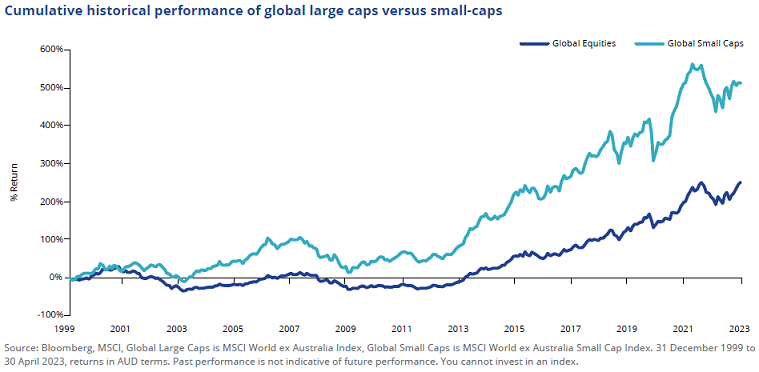
Emanuel Datt notes that this persistent gap creates an opportunity for investors who apply independent analysis rather than relying on index movements.
This gap is beginning to narrow as macro conditions stabilise. Investors are allocating capital towards companies with sound unit economics and improving earnings visibility. The dispersion in fundamentals remains significant, providing a favourable environment for research led stock selection.
The Datt Small Companies Fund is designed to take advantage of mispriced opportunities outside the ASX 100. The strategy focuses on high quality Australian small companies with clear operating leverage, disciplined capital management and the capacity to compound value through a full market cycle.
The fund typically holds 15 to 25 positions. This creates a concentrated but risk aware structure that focuses on conviction rather than broad diversification. The approach remains sector agnostic, with recent contributors coming from both resources and technology.
Emanuel emphasises the importance of independent primary research. The team builds conviction before the market recognises value, supported by a research framework that avoids external consensus.
“We do all our own primary research, building independent conviction before the market does,” Emanuel says. “Our alignment with investors ensures we share the same outcomes.”
Gold producers have benefited from strong pricing and investor demand for defensive assets. Within this theme, positions such as Meeka Metals, Genesis Minerals and and General Minerals have been supported by improving production profiles and stronger balance sheet visibility.
“The company (Meeka Metals) re in a pretty unique situation for a small gold producer in the sense that in the sense that they are quite long ore.
“They’ve got a good asset, they’ve got a very competent and well aligned team to run it, and they’re economically robust in the sense that they haven’t taken up debt or been too aggressive in their financing.”
Companies tied to domestic resource development are finding renewed support as Australia focuses on supply resilience and processing capability.
The key question in Australian technology is who captures the productivity upside from enterprise automation and AI adoption. Select firms with repeatable revenue, disciplined cost structures and scalable platforms are positioned to benefit.
These areas share a common feature. Their fundamentals have improved faster than their share prices.
Several market forces support the re-emergence of undervalued opportunities across Australian small companies.
Small companies often lead early in market recoveries. They benefit from operating leverage, M&A activity and capital flows. Yet they remain under owned after years of relative weakness. The current environment presents a rare window for investors who apply disciplined research and maintain a long term mindset.
At Datt Capital, independent research and alignment with investors are central to this process. We continue to focus on high quality businesses positioned to benefit from Australia’s next growth cycle while maintaining a focus on capital preservation.
To explore how the Datt Small Companies Fund targets undervalued opportunities in the Australian market, visit our Small Companies Fund page or contact Daniel Liptak, Head of Distribution, at daniel@datt.com.au.
Typically companies outside the ASX 100 with smaller market capitalisation and higher growth potential.
They have underperformed for several years and now trade at discounts to large cap peers despite improving fundamentals.
Disclaimer: This article does not take into account your investment objectives, particular needs or financial situation; and should not be construed as advice in any way. The author may hold stocks discussed in this article. Forward-looking statements reflect the author's views at the time of writing and are subject to change. Past performance is not indicative of future results.

Investment Excellence with a Proven Edge
Datt Capital Pty Ltd
ABN 37 124 330 865
AFSL 542100
390 St Kilda Rd, Melbourne VIC 3004
© COPYRIGHT 2025. ALL RIGHTS RESERVED.
Datt Capital Pty Ltd
ABN 37 124 330 865
AFSL 542100
390 St Kilda Rd, Melbourne VIC 3004
© COPYRIGHT 2026. ALL RIGHTS RESERVED.
The information on this website is prepared and issued by Datt Capital Pty Ltd (ABN 37 124 330 865 AFSL 542100) (Datt Capital). Unless otherwise stated, the information is intended for wholesale clients within the meaning of section 761G or 761GA of the Corporations Act 2001 (Cth) (Corporations Act).
Datt Capital is the investment manager of the Datt Capital Absolute Return Fund (APIR FHT3309AU), the Datt Small Companies Fund Class A (APIR FHT4217AU), and the Datt Small Companies Fund Class B (APIR FHT4217AU) (together, the Funds). Fundhost Limited (ABN 69 092 517 087 AFSL 233045) (Fundhost) is the issuer and trustee of each Fund.
The Datt Capital Absolute Return Fund and the Datt Small Companies Fund Class A are available to wholesale investors only and must not be made available to any persons that are "retail clients" for the purpose of the Corporations Act. An investment in either of these Funds is available directly through a valid application form attached to the relevant information memorandum, through the Olivia123 direct application platform, or through selected investor directed portfolio service (IDPS) platforms. Before making any decision to make or hold any investment in either Fund you should consider the relevant information memorandum in full. The Datt Small Companies Fund Class B is available to retail investors only, exclusively through selected investor directed portfolio service (IDPS) platforms. Before making any decision to make or hold any investment in this Fund you should consider the relevant Product Disclosure Statement (PDS) in full. The PDS is available on request by contacting Datt Capital directly.
The information contained on this website or in any email is not intended for distribution to, or use by, any person or entity in any jurisdiction or country where such distribution or use would be contrary to law or regulation, or which would subject Datt Capital or Fundhost to any registration or other requirement within such jurisdiction or country. Datt Capital may provide general information to help you understand our investment approach. Any financial advice we provide has not considered your personal circumstances and may not be suitable for you. To the extent permitted by law, Datt Capital and Fundhost, their officers, employees, consultants, advisers and authorised representatives, are not liable for any loss or damage arising as a result of any reliance placed on this document. Information has been obtained from sources believed to be reliable, but we do not represent it is accurate or complete, and it should not be relied upon as such. Datt Capital and Fundhost do not guarantee investment performance or distributions, and the value of your investment may rise or fall. Past performance is not an indicator of future performance.