Explore eight key insights from the AI repricing and what it means for technology stocks, productivity gains, and long-term investment opportunities.
~ 4 min. read
By: Datt Capital

Artificial Intelligence (AI) is rapidly reshaping global equity markets and challenging traditional business models.
However, according to Datt Capital CIO Emanuel Datt, the long-term implications are overwhelmingly positive for companies and investors.
Rather than representing a destructive force, AI is accelerating productivity improvements across multiple sectors. The latest reporting season is already revealing tangible evidence of these changes.
Below are eight insights shaping how investors should think about AI, markets, and long-term opportunities.
AI is clearly changing the competitive landscape across global markets. The speed at which AI capabilities are advancing has forced many investors to reconsider the sustainability of traditional business models, particularly in technology and software sectors.
However, disruption alone does not determine long-term outcomes. Technological shifts historically create both uncertainty and opportunity.
Emanuel notes that the current narrative around AI is not necessarily pessimistic.
“It’s not all negative. Ultimately, it’s about increasing productivity and efficiency, which is good for company owners and shareholders.” - says Emanuel.
The most compelling evidence supporting the AI productivity narrative is emerging from corporate reporting results.
Companies actively adopting AI tools are already demonstrating measurable improvements in operational efficiency. These improvements are not theoretical. They are appearing in real financial results during the current reporting season.
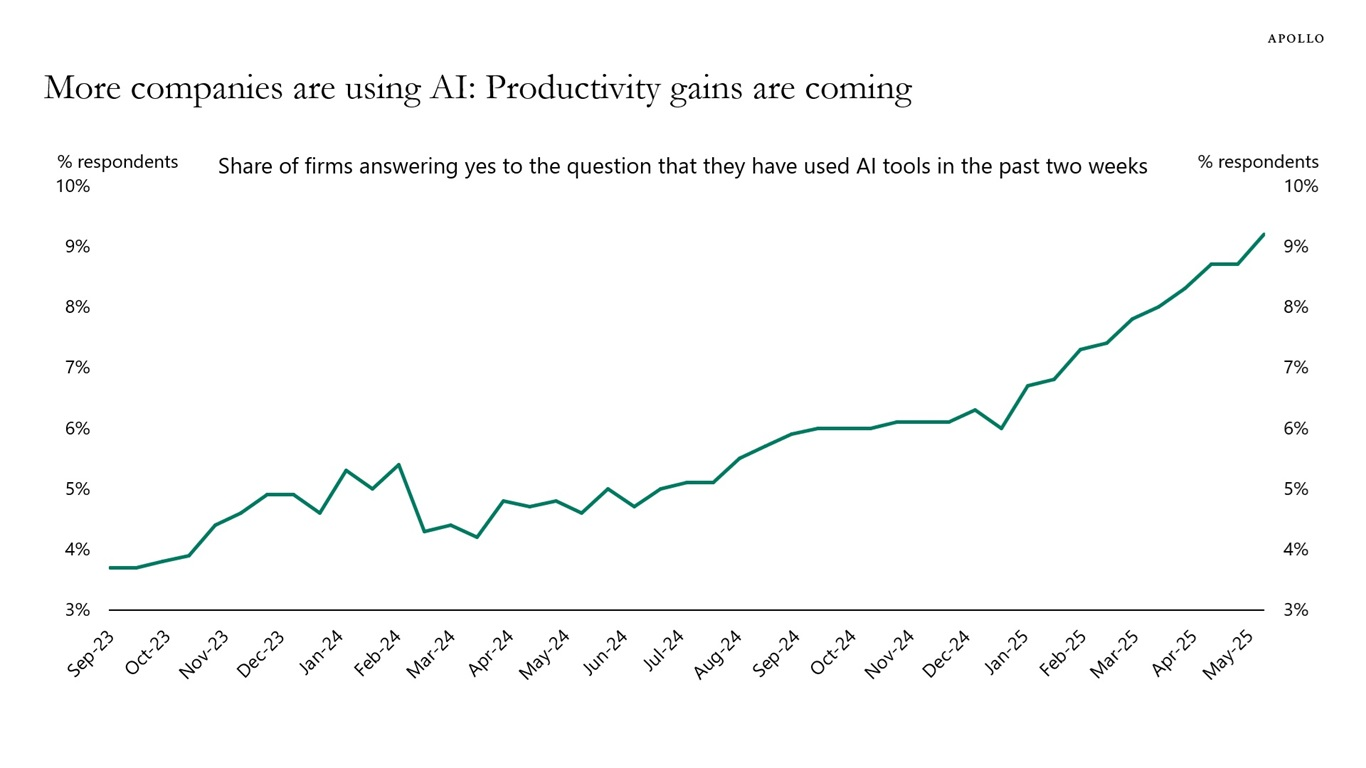
Insights: Corporate adoption of AI tools is accelerating rapidly. Survey data shows that the share of firms actively using AI has more than doubled since late 2023, highlighting how quickly the technology is moving from experimentation to operational deployment.
“We are already seeing very tangible productivity benefits playing out in real time, especially in the current reporting season.” - says Emanuel
For investors, this suggests that AI adoption is beginning to influence business performance today rather than remaining a distant future trend.
Historically, operational improvements within large organisations were incremental. Productivity improvements were often measured in basis points through gradual optimisation of processes and workflows.
The introduction of AI is changing that dynamic.
Companies are now reporting efficiency improvements measured in percentage points rather than basis points. For large organisations, even small percentage improvements in productivity can materially improve profitability.
This shift highlights how AI has the potential to transform operational efficiency across industries.
The rapid emergence of AI has triggered significant volatility within technology markets. Investors have become concerned that AI may disrupt established software and SaaS business models.
As a result, technology stocks have experienced a significant sell-off in recent months.
However, Emanuel Datt views this repricing as a recalibration rather than a structural deterioration.
“The recent pullback in technology stocks is not evidence of structural weakness but a recalibration.” - says Emanuel.
In many cases, companies are continuing to report strong operational performance despite the negative market reaction.
One of the most common concerns surrounding AI is the possibility that automation will replace large segments of the workforce.
While AI-driven efficiency gains may reduce certain roles, the broader economic impact is more likely to resemble previous technological transitions.
“AI-driven efficiency gains may result in workforce reductions in some areas, but this is a broader economic evolution rather than a crisis.” - Emanuel noted.
Historically, technological advancements have shifted the nature of work rather than eliminating economic activity altogether.
As AI technology becomes more widely accessible, the competitive advantage will increasingly shift toward companies that control valuable data assets.
AI models themselves may eventually become commoditised as open-source alternatives expand and computing power becomes more accessible.
However, proprietary data remains scarce.
Businesses that generate and control unique data streams will have a significant advantage when deploying AI to improve decision making, optimise operations, and create new services.
"The answer is unambiguous in that value lies in contemporary, proprietary data streams and the high-quality business franchises that control them."- says Emanuel.
While technology companies are the most obvious beneficiaries of AI adoption, productivity gains are emerging across a wide range of sectors.
Financial institutions, logistics companies, and mining operations are already deploying advanced systems to improve operational efficiency.
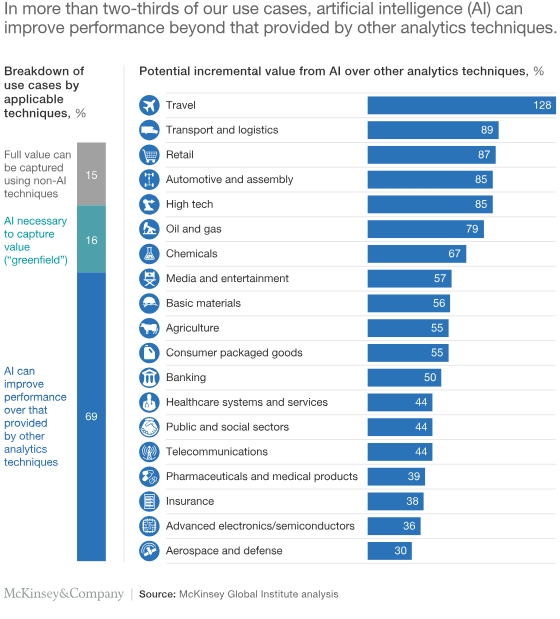
“Even traditionally bureaucratic sectors such as banking are prime beneficiaries.” - says Emanuel.
In Australia, large resource companies have also been integrating advanced systems to optimise equipment utilisation and operational planning.
Technological transitions often create uncertainty within markets. When investors struggle to assess the long-term impact of new technologies, volatility typically increases.
However, market volatility can also create investment opportunities.
The recent sell-off in technology stocks has pushed valuations lower even as many companies continue to improve operational performance.
“Parts of the technology sector now represent better value than they have for years.”
For disciplined investors, periods of market uncertainty can present opportunities to acquire high-quality businesses at attractive valuations.
Artificial intelligence represents one of the most significant technological shifts in modern economic history. While the transition is creating short-term uncertainty across markets, the underlying productivity benefits are becoming increasingly visible.
Companies that successfully integrate AI into their operations and leverage proprietary data assets are likely to emerge as the long-term winners.
For investors willing to look beyond short-term narratives, the AI transition may ultimately represent a powerful opportunity rather than a structural threat.
Artificial intelligence relies heavily on physical infrastructure such as data centres and computing hardware. However, the economic power within the AI ecosystem increasingly sits with large technology platforms rather than infrastructure providers.
While data centres remain essential, they are becoming more commoditised as competition grows and global capacity expands. Large technology companies typically hold greater negotiating power, as they control the software platforms, customer relationships, and distribution channels through which AI services are delivered.
This poses an important structural lesson. In many technology cycles, infrastructure providers supply the backbone of innovation, but long term value creation tends to concentrate in companies that control the platforms and ecosystems.
Disclaimer: This article does not take into account your investment objectives, particular needs or financial situation; and should not be construed as advice in any way. The author may hold stocks discussed in this article. Forward-looking statements reflect the author's views at the time of writing and are subject to change. Past performance is not indicative of future results.

Investment Excellence with a Proven Edge
Datt Capital Pty Ltd
ABN 37 124 330 865
AFSL 542100
390 St Kilda Rd, Melbourne VIC 3004
© COPYRIGHT 2025. ALL RIGHTS RESERVED.
Datt Capital Pty Ltd
ABN 37 124 330 865
AFSL 542100
390 St Kilda Rd, Melbourne VIC 3004
© COPYRIGHT 2026. ALL RIGHTS RESERVED.
The information on this website is prepared and issued by Datt Capital Pty Ltd (ABN 37 124 330 865 AFSL 542100) (Datt Capital). Unless otherwise stated, the information is intended for wholesale clients within the meaning of section 761G or 761GA of the Corporations Act 2001 (Cth) (Corporations Act).
Datt Capital is the investment manager of the Datt Capital Absolute Return Fund (APIR FHT3309AU), the Datt Small Companies Fund Class A (APIR FHT4217AU), and the Datt Small Companies Fund Class B (APIR FHT4217AU) (together, the Funds). Fundhost Limited (ABN 69 092 517 087 AFSL 233045) (Fundhost) is the issuer and trustee of each Fund.
The Datt Capital Absolute Return Fund and the Datt Small Companies Fund Class A are available to wholesale investors only and must not be made available to any persons that are "retail clients" for the purpose of the Corporations Act. An investment in either of these Funds is available directly through a valid application form attached to the relevant information memorandum, through the Olivia123 direct application platform, or through selected investor directed portfolio service (IDPS) platforms. Before making any decision to make or hold any investment in either Fund you should consider the relevant information memorandum in full. The Datt Small Companies Fund Class B is available to retail investors only, exclusively through selected investor directed portfolio service (IDPS) platforms. Before making any decision to make or hold any investment in this Fund you should consider the relevant Product Disclosure Statement (PDS) in full. The PDS is available on request by contacting Datt Capital directly.
The information contained on this website or in any email is not intended for distribution to, or use by, any person or entity in any jurisdiction or country where such distribution or use would be contrary to law or regulation, or which would subject Datt Capital or Fundhost to any registration or other requirement within such jurisdiction or country. Datt Capital may provide general information to help you understand our investment approach. Any financial advice we provide has not considered your personal circumstances and may not be suitable for you. To the extent permitted by law, Datt Capital and Fundhost, their officers, employees, consultants, advisers and authorised representatives, are not liable for any loss or damage arising as a result of any reliance placed on this document. Information has been obtained from sources believed to be reliable, but we do not represent it is accurate or complete, and it should not be relied upon as such. Datt Capital and Fundhost do not guarantee investment performance or distributions, and the value of your investment may rise or fall. Past performance is not an indicator of future performance.