
The Datt Capital Absolute Return Fund ranked #1 among Australian alternative funds for the 12 months to September 2025, returning 33%. Explore the strategy behind the result.
~ 6 min. read
By: Datt Capital

Investors evaluating the best managed funds in Australia in 2025 are increasingly looking beyond traditional equity benchmarks. Persistent inflation, shifting interest rate expectations, and uneven global growth have made capital preservation and flexibility central to fund selection. Alternative managed funds, and absolute return strategies in particular, have emerged as a significant allocation consideration for SMSFs, family offices, high-income professionals, and institutional investors.
This article outlines what managed funds are, how alternative strategies fit within that universe, and which funds have delivered the strongest outcomes over the past year based on third-party performance data.
A managed fund pools capital from multiple investors and deploys it according to a defined investment strategy. Fund managers make decisions on behalf of investors, applying research, risk management, and portfolio construction to pursue a stated objective.
Managed funds in Australia span several categories:
For investors comparing managed funds, the relevant question is not just which fund returned the most over a given period. It is which fund delivered returns appropriate to its risk objective, and whether those returns are repeatable through different market conditions.
Traditional equity funds performed strongly during the extended bull market that followed the 2020 correction. However, the environment has shifted. Equity valuations in major markets remain elevated, interest rate uncertainty has not fully resolved, and geopolitical risks, including the ongoing Middle East conflict and trade policy instability, continue to create volatility in global supply chains and risk assets.
In this environment, alternative managed funds offer a different return profile. Rather than tracking an index, they aim to generate positive returns across market cycles by adjusting exposure, managing downside risk actively, and identifying mispriced opportunities where the broader market has not yet repriced. For a deeper look at why absolute return investing matters in today's market, the case for flexibility in portfolio construction has rarely been stronger.
For investors focused on capital preservation, this approach offers a structural advantage: the primary objective is not to beat a benchmark, it is to protect and compound capital over time.
For the 12 months to September 2025, Morningstar performance data published by Livewire Markets identified the top performing managed funds across Australian asset classes. Within the alternatives category, absolute return strategies delivered some of the strongest relative outcomes of the period.
The Datt Capital Absolute Return Fund ranked first among Australian alternative managed funds for the 12 months to September 2025, returning 33.03% over the period.
Key performance figures:

These results place the Fund ahead of both equity-focused and diversified alternative peers over the measurement period. Understanding how disciplined investing delivered consistent returns across varying market conditions provides useful context for evaluating this outcome.
The Datt Capital Absolute Return Fund (APIR: FHT3309AU) is an actively managed strategy investing in listed Australian equities. The Fund takes a long-only approach and focuses on identifying undervalued opportunities within Australian small and mid-cap companies, while actively managing downside risk at the portfolio level.
The investment process is built on four principles:
The strategy is designed to remain adaptive rather than benchmark-constrained, reducing drawdown risk during periods when broader equity markets face valuation pressure or elevated volatility.
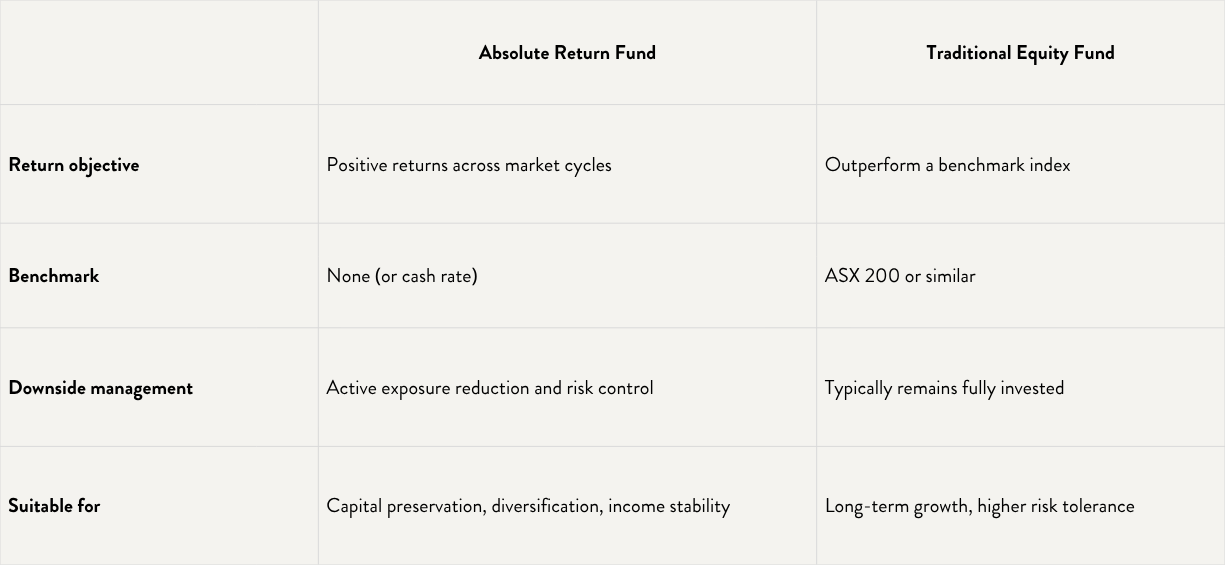
Understanding the difference between absolute return funds and traditional equity funds is important for investors assessing which strategy suits their objectives. For investors who have accumulated significant capital and prioritise its protection, absolute return funds offer a fundamentally different risk profile to traditional equity strategies.
Capital preservation has moved from a secondary consideration to a primary one for many Australian investors in 2025. Three factors explain this shift.
First, sequence of returns risk is more visible. Retirees and near-retirees drawing income from their portfolio are acutely exposed to early-period drawdowns. Understanding sequence of returns risk and the limits of average returns is essential for anyone managing a retirement income strategy. A managed fund that limits losses during downturns produces materially better long-term outcomes than one that recovers the same return through larger swings.
Second, equity market valuations remain stretched in key segments. Concentration in large-cap technology names has left many index-tracking funds with significant single-sector exposure. Alternative managed funds with active risk management offer a way to reduce that concentration risk.
Third, rate uncertainty has not resolved. With the RBA navigating a difficult inflation and growth balance, fixed income is not providing the same hedging benefit it historically has. Absolute return strategies offer a different form of defensiveness.
For a broader perspective on how capital preservation drives long-term growth, the relationship between downside protection and compounding returns is more significant than most investors appreciate.
Absolute return and alternative managed funds are typically suited to investors who:
This includes affluent retirees and SMSF trustees managing their own investment portfolios, high-income professionals seeking tax-effective growth with lower volatility, family offices with a multi-generational capital preservation mandate, and institutional investors seeking uncorrelated return streams within diversified portfolios.
Investors comparing managed funds in Australia should evaluate the following:
According to Morningstar data published by Livewire Markets, the Datt Capital Absolute Return Fund ranked first among Australian alternative managed funds for the 12 months to September 2025, returning 33.03% over the period. Performance rankings vary across categories and time periods. Investors should assess funds against their own objectives and risk tolerance.
Absolute return funds are specifically designed with capital preservation as a primary objective. The best managed funds for capital preservation actively manage downside risk, use flexible exposure management, and are not constrained by benchmark weights. The Datt Capital Absolute Return Fund has delivered a five-year annualised return of 19.55% with this objective at its core.
An absolute return fund is a managed investment strategy designed to generate positive returns over time regardless of market direction. Unlike traditional equity funds, it does not aim to outperform a benchmark. Instead, it focuses on preserving capital and compounding returns through varying market conditions using flexible exposure management and active risk control.
Equity funds are typically benchmark-relative and remain fully invested regardless of market conditions. Alternative managed funds aim to deliver positive returns independent of benchmarks by adjusting exposure, managing downside risk actively, and identifying opportunities across different market environments.
Absolute return funds still carry investment risk. However, their primary objective is to reduce drawdowns and volatility compared with traditional equity markets. Risk is managed through position sizing, valuation discipline, and the ability to reduce exposure during unfavourable conditions.
Investors should assess the investment process, risk management approach, alignment of the manager with investors, long-term performance across full market cycles, fee structure, and transparency of reporting. Consistency and discipline across different market conditions matter more than short-term returns in isolation.
The Datt Capital Absolute Return Fund is available to wholesale and sophisticated investors, including SMSFs that meet the relevant eligibility criteria. The minimum investment is $100,000. Investors should consult a licensed financial adviser to assess suitability for their specific circumstances.
Disclaimer: This article does not take into account your investment objectives, particular needs or financial situation; and should not be construed as advice in any way. The author may hold stocks discussed in this article. Forward-looking statements reflect the author's views at the time of writing and are subject to change. Past performance is not indicative of future results.

Investment Excellence with a Proven Edge
Datt Capital Pty Ltd
ABN 37 124 330 865
AFSL 542100
390 St Kilda Rd, Melbourne VIC 3004
© COPYRIGHT 2025. ALL RIGHTS RESERVED.
Datt Capital Pty Ltd
ABN 37 124 330 865
AFSL 542100
390 St Kilda Rd, Melbourne VIC 3004
© COPYRIGHT 2026. ALL RIGHTS RESERVED.
The information on this website is prepared and issued by Datt Capital Pty Ltd (ABN 37 124 330 865 AFSL 542100) (Datt Capital). Unless otherwise stated, the information is intended for wholesale clients within the meaning of section 761G or 761GA of the Corporations Act 2001 (Cth) (Corporations Act).
Datt Capital is the investment manager of the Datt Capital Absolute Return Fund (APIR FHT3309AU), the Datt Small Companies Fund Class A (APIR FHT4217AU), and the Datt Small Companies Fund Class B (APIR FHT4217AU) (together, the Funds). Fundhost Limited (ABN 69 092 517 087 AFSL 233045) (Fundhost) is the issuer and trustee of each Fund.
The Datt Capital Absolute Return Fund and the Datt Small Companies Fund Class A are available to wholesale investors only and must not be made available to any persons that are "retail clients" for the purpose of the Corporations Act. An investment in either of these Funds is available directly through a valid application form attached to the relevant information memorandum, through the Olivia123 direct application platform, or through selected investor directed portfolio service (IDPS) platforms. Before making any decision to make or hold any investment in either Fund you should consider the relevant information memorandum in full. The Datt Small Companies Fund Class B is available to retail investors only, exclusively through selected investor directed portfolio service (IDPS) platforms. Before making any decision to make or hold any investment in this Fund you should consider the relevant Product Disclosure Statement (PDS) in full. The PDS is available on request by contacting Datt Capital directly.
The information contained on this website or in any email is not intended for distribution to, or use by, any person or entity in any jurisdiction or country where such distribution or use would be contrary to law or regulation, or which would subject Datt Capital or Fundhost to any registration or other requirement within such jurisdiction or country. Datt Capital may provide general information to help you understand our investment approach. Any financial advice we provide has not considered your personal circumstances and may not be suitable for you. To the extent permitted by law, Datt Capital and Fundhost, their officers, employees, consultants, advisers and authorised representatives, are not liable for any loss or damage arising as a result of any reliance placed on this document. Information has been obtained from sources believed to be reliable, but we do not represent it is accurate or complete, and it should not be relied upon as such. Datt Capital and Fundhost do not guarantee investment performance or distributions, and the value of your investment may rise or fall. Past performance is not an indicator of future performance.